A police scanner antenna booster can help in some receiving setups, but it is not a guaranteed cure for weak or broken audio. The useful question is what is causing the problem: a poor antenna location, cable loss, interference, an overloaded receiver or a system your scanner cannot decode. Work that out first and you can avoid buying equipment that makes reception worse.
In my own setup, I have experimented with a TV antenna amplifier while listening from a mountainous area. The video below shows that approach. It is one setup to investigate, rather than proof that every TV amplifier will work with every scanner.
Watch the Scanner Antenna Booster Video
How a Police Scanner Antenna Booster Works
An antenna amplifier increases the level of the RF signal passing through it. It does not selectively improve the conversation you want to hear: unwanted signals and noise can be amplified too. That is why a stronger signal indication does not always mean clearer audio.
Amplification may be useful when a suitable signal reaches the antenna but loses strength through a long cable or distribution system. If the antenna is poorly positioned or receives mostly interference, fixing that problem first is usually a better starting point.
Police Scanner Antenna Booster or Better Antenna?
Try moving the existing antenna before adding electronics. A different room, higher position or spot farther from a noisy charger can change reception. Check that the antenna covers your target frequencies and that the connector is seated correctly.
An outdoor antenna can offer different placement options, but consider the whole installation: cable length, cable loss, connectors and mounting. If you are also comparing wideband listening equipment, our Y23UV-98 Plus receiving guide explains why frequency coverage and decoding capability are separate questions.
Can You Use a TV Antenna Amplifier with a Scanner?
Sometimes, but compatibility depends on the amplifier. TV equipment is designed around television reception, not every frequency a scanner may tune. Read its passband and filter specifications rather than choosing only by the advertised gain.
For example, some TV LTE filters block signals above 608MHz. Such filtering is unsuitable when you want to receive signals in the 700MHz or 800MHz ranges. An amplifier can be working exactly as designed while reducing the scanner signal you wanted.
Also check how the amplifier receives power. Some systems send DC along the coax through a power inserter. Follow the manufacturer’s diagram and keep DC away from a scanner input unless its documentation explicitly permits it. Do not assume an F-to-BNC adapter provides electrical isolation.
Parts to Check Before Buying
Antenna and Coaxial Cable
Choose the antenna for the bands you actually monitor. A broad advertised frequency range does not mean equal performance everywhere. Keep the cable run practical and compare cable loss at your highest target frequency.
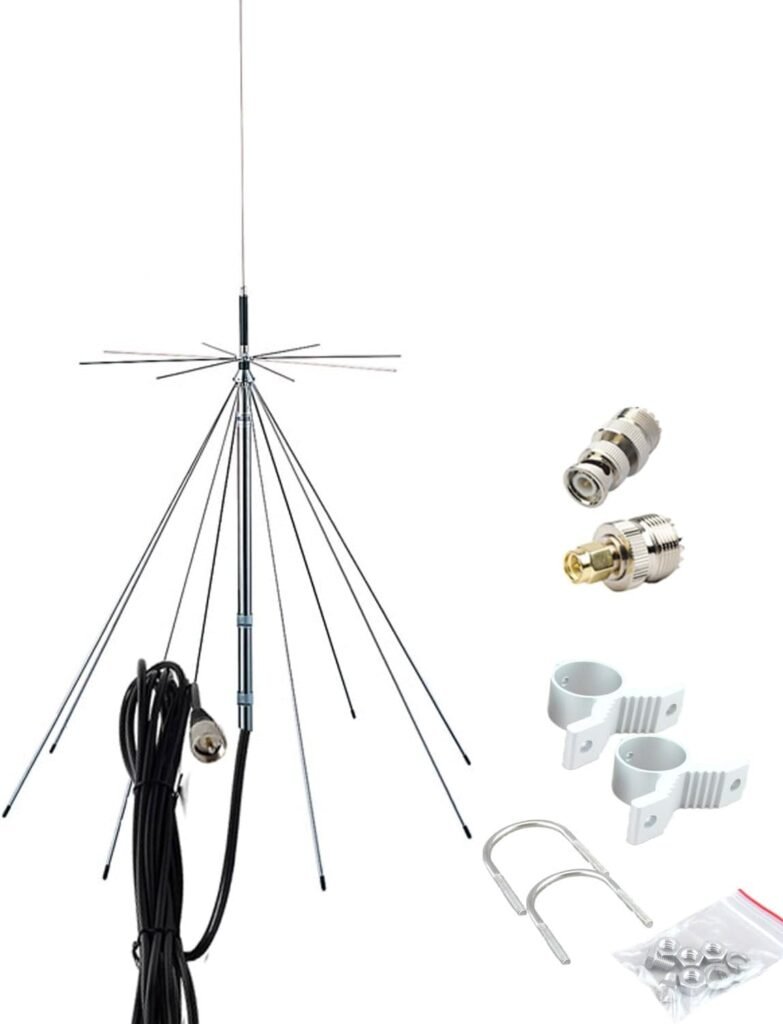
The original project linked to this discone-style scanner antenna. Review the listing’s dimensions, connector and installation requirements before selecting it. It is an antenna example, not a promise of reception at a particular distance.
Connectors and Adapters
Identify the scanner’s antenna connector before ordering. BNC, SMA and F connectors are different, and connector gender matters. Use as few adapters as practical and avoid hanging a heavy cable assembly directly from a small handheld socket.
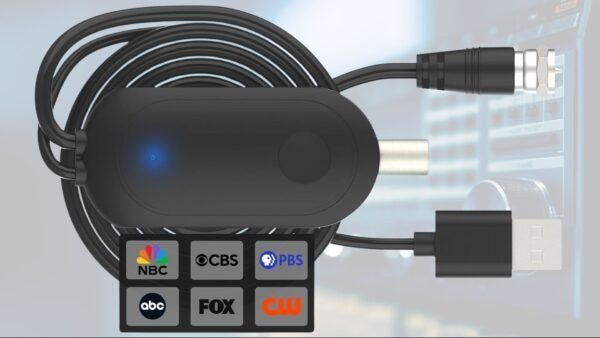
Compare the F-to-BNC adapter from the original project with the connectors on your own cable and scanner. For cable shopping, compare RG6 cable lengths and connector options; check suitability for your complete receiving setup rather than copying a length unnecessarily.
Amplifier Bandwidth, Gain and Power
The original project included TV amplifier and wideband RF amplifier examples. Neither category is a universal recommendation. Ask whether the device passes your target bands, whether gain is adjustable and how it handles strong nearby signals. More gain is not automatically better.
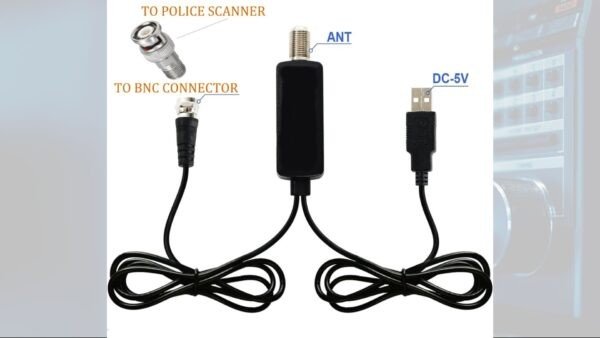
You can inspect the TV antenna amplifier example and wideband RF amplifier example from the original article. Verify their specifications and power arrangements before connecting either one. A scanner-specific or band-appropriate preamplifier may be a more suitable choice.
Test Reception One Change at a Time
- Start with the scanner connected directly to the antenna and record which channels work reliably.
- Check programming, enabled systems, service types and squelch before changing hardware.
- Compare antenna positions and inspect the cable and connectors.
- If the amplifier is compatible, connect it exactly as its instructions specify and begin with the lowest available gain.
- Compare understandable audio and reliable decoding, not just the signal-strength display.
- Bypass the amplifier again to confirm whether it actually improved reception.
If more gain introduces new noise, missing channels or worse audio, remove it and reassess. Where your scanner provides attenuation, testing that setting can help reveal whether strong signals are part of the problem. Consult the instructions for your scanner model.
Problems an Amplifier Cannot Fix
Unsupported Digital Systems or Encryption
An amplifier cannot add a digital mode the scanner does not support, follow an unsupported trunking system or decode encrypted conversations. Confirm compatibility with the system you want to monitor before spending money on antenna accessories.
Simulcast Distortion and Strong-Signal Overload
Broken digital audio is not always caused by a weak signal. Simulcast reception and strong nearby transmitters can require a different approach. Adding gain blindly may make diagnosis harder. Try the scanner manufacturer’s recommended settings and compare locations before assuming a booster is the answer.
Poor Outdoor Installation
An amplifier cannot repair damaged coax, water-filled connectors or an unsuitable mount. Keep outdoor antennas clear of power lines and follow the equipment instructions for grounding, weatherproofing and lightning protection. Get qualified installation help where needed.
Is a Scanner Antenna Booster Worth Trying?
It can be worth a controlled test when you have identified cable loss and confirmed the amplifier’s compatibility. It is a less convincing first purchase when you have not yet checked antenna position, programming or the type of radio system involved.
Start with the simplest working setup, change one thing and keep what improves the actual listening experience. If you are exploring other forms of radio listening, see our budget shortwave receiver guide. For local amateur two-way radio options, compare the Yaesu FT-65R buying guide.